Lazarus Ball
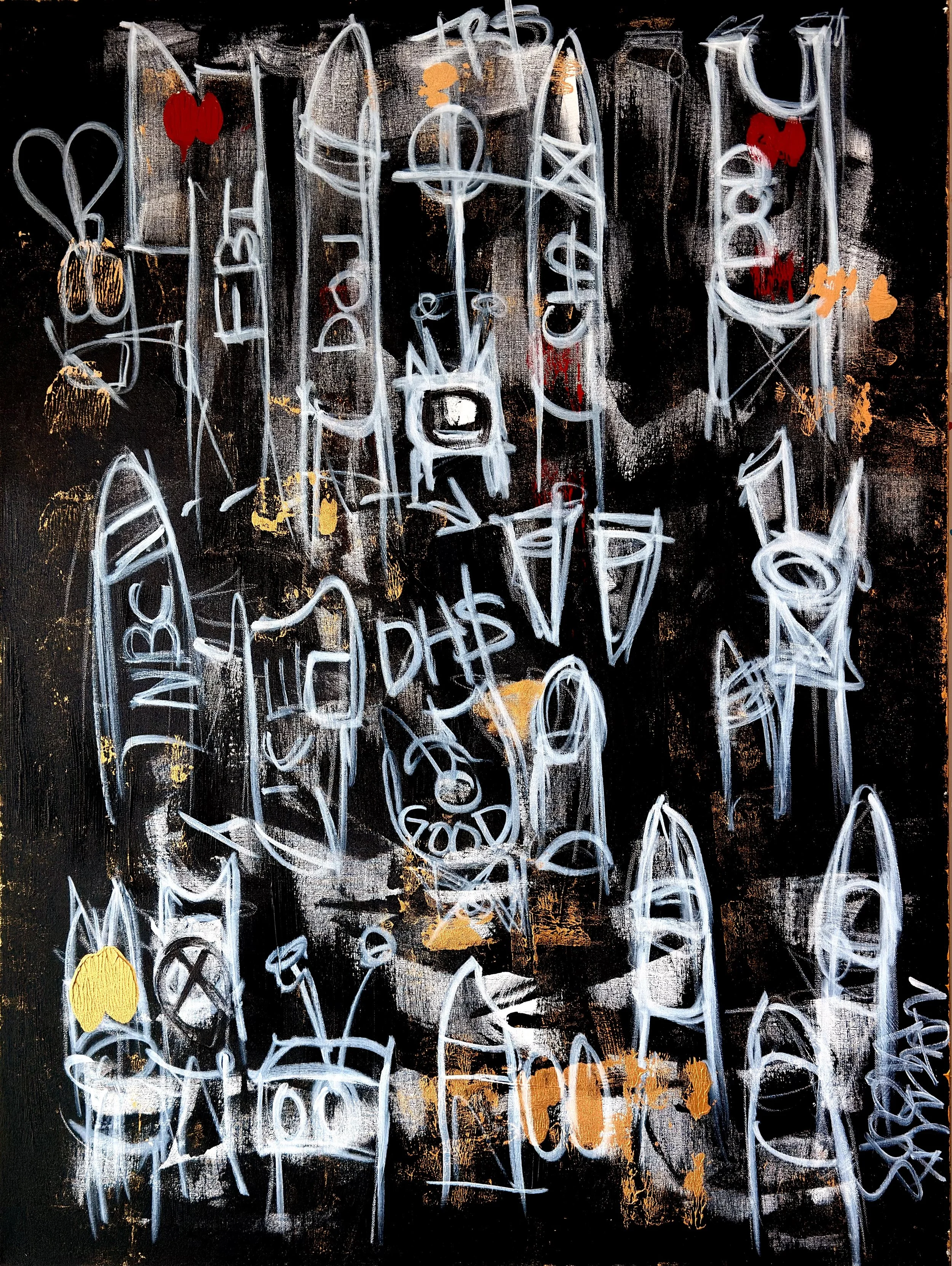
Battle of Minneapolis,
36” x 48”, acrylic on canvas
©Macaulay Woods 2026
Lazarus Ball (2024–2026)
Corruption as a cause of death is examined in this body of work.
Lazarus Ball is the culmination of two years of painting made under considerable pressure. What started as a short series called Grief and Ghosts in 2024 evolved into a body of work that is now structured as four books—Book of the Heart, Book of the Dead, Book of the Sky, and Book of the Night. The series moves across registers of grief, witness, mass surveillance, and oppression.
The Book of the Heart began as a response to personal grief and the powerlessness that I felt in trying to navigate an impossible and corrupt medical system.
In late 2024, I encountered the Egyptian Book of the Dead. As I pored through the text and all of the rich iconographic imagery, I started to draw parallels between the plight of the people in war-torn Gaza, the afterlife, and the central figures in the Netherworld.
The Book of the Dead holds Gaza: two years of unrelenting bombing, starvation, and the systematic targeting of civilians, hospitals, schools, and civil systems while people in power enabled unprecedented obliteration with their silence.
The Book of the Sky considers how the infrastructures of civilization are rapidly adapting to AI. It posits that global society was not given a choice in this evolution of technology as it becomes exceedingly more omniscient and powerful. As AI rapidly expands, data centers are being swiftly built across the United States in places where ordinary people lack the resources to defend themselves against corporate land and water grabs.
In 2024 and 2025, I used Instagram to create and distribute animations as a response to the carnage that I saw happening to the civilians in Gaza. I developed a system of action painting using blocks of paint and brayers. What resulted were both narrative stories and fractured color fields populated with biomorphic shapes. I took the details of the figures and made multimedia reels. The figures became casualties of war and the canvas was the battlefield.
I started the Book of the Night more as an extension of the Book of the Dead series rather than as an independent book. I was hacked in August 2025 by individuals pretending to be various gallerists. These individuals took over all of my online accounts, numerous phone lines, blocked calls and emails, and invaded my privacy in many ways that were done in the dark under the cloak and strategy of digital intrusions. Digital works, files, photographs, writings, and iCloud archives were stolen, along with the photographic history of my work and records of personal grief. I stopped painting from August 2025 until January 2026, as I attempted to regain control of my accounts—and then ten paintings were rapidly produced in black, white, gold, and red. The Book of the Night maps the mechanisms of the blanket systemic oppression of free speech. The work examines the modern systems of techno-fascist surveillance that track our daily lives, police our speech and right to protest, thus impinging upon our collective civil liberties. It examines the prevalent surveillance culture that we now live in due to the accelerated spread of digital systems.
The Battle of Minneapolis centers on a woman named Good, who was executed in the street after blowing whistles and attempting to drive away from an officer, and all of the bureaucratic agencies that our country has become reduced to that enable such impunity. The Complicit reveals a group of powerful people with dollar signs for eyes and X's over their mouths who sold their silence to keep their clout. Kompromat confronts the hierarchy of power that makes complicity possible—blackmail, predators in paradise, voiceless children, and the handpicked politicians who look the other way. The bright colors were intentionally chosen to mirror the happy and carefree island lifestyle of the rich individuals who lured innocents toward predators lying in wait.
Lazarus Ball is a response to what corruption has done, to a family, to a people, to a planet, by systems that depend upon silence to exist. The mechanisms that kill are the same— whether the victim is a child in Gaza, an elder in a corporate care facility, a young man failed by a captured regulatory system, or a woman named Good who deserved to live.
Macaulay Woods
July 2026